
UK Tobacco Track and Trace Procurement: An Opportunity to Enhance Supply Chain Control
On 14 October, HM Revenue & Customs (HMRC) published a preliminary market engagement notice ahead of the procurement of the next UK tobacco track and trace system.
The exercise gives potential suppliers an opportunity to review the draft requirements and provide feedback before the formal procurement. HMRC has indicated that detailed operational, technical, performance, security and transition requirements may be further refined during the process.
The International Tax Stamp, Authentication and Traceability Association (ITSA) believes this presents an important opportunity to strengthen the UK's tobacco control infrastructure by combining digital traceability with robust physical authentication measures, building on the approach HMRC has already adopted for its new vaping duty stamps.
The procurement documentation indicates an estimated contract period from April 2027 to April 2032, with a possible extension to 2034.
The need for robust protection is particularly relevant given the continuing growth of illicit tobacco in the UK. According to HMRC's latest official figures, the cigarette duty gap stood at 12% in 2024/25, while the hand-rolling tobacco duty gap was 22.9%. HMRC also reported record seizures of around 1.9 billion cigarettes worth approximately £1.1 billion in 2025/26 [1].
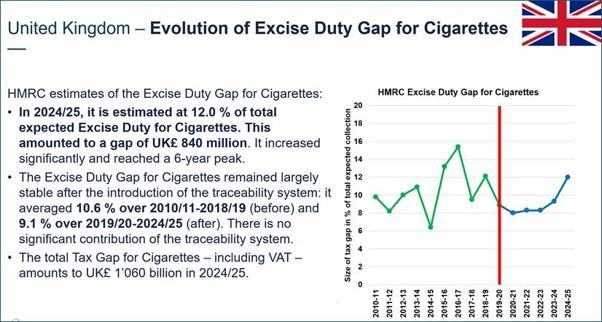
These figures are especially relevant in a country where legitimate cigarettes are exceptionally expensive. An international comparison published in 2026 places the UK fourth among 186 countries for the retail price of a pack of 20 cigarettes, behind Australia, New Zealand and Ireland [2].
High legitimate market prices increase the importance of ensuring that excise and tobacco control policies are supported by the strongest available tools against illicit trade.
The importance of robust security measures becomes even clearer when considering the enormous disparity between the production cost and retail price of cigarettes.
With the estimated cost of producing a pack at just 10-20 cents, compared with a UK retail price that can be up to 100 times higher, the potential financial rewards from illicit trade are substantial. In effect, a pack of cigarettes can carry a retail value equivalent to a £15 banknote.
Lessons from vaping duty stamps
HMRC itself now has another useful reference point. Under the UK's new vaping duty stamps scheme, the authority has adopted a combined physical and digital approach. The duty stamp contains multiple physical security features, while its digital component provides a scannable code supporting authentication and supply-chain tracing.
ITSA argues that this approach provides a useful precedent for strengthening the UK's tobacco control system, and that similar principles should be considered as part of HMRC's forthcoming procurement.
Digital track and trace is essential for recording legitimate supply chain movements, identifying vulnerabilities and detecting illicit activity. However, digital identifiers can be copied, reused or misused, making complementary physical authentication measures valuable. This argument has also been put forward in correspondence concerning the procurement, highlighting the additional safeguards offered by combining digital tracking with robust, multilayered physical security features.
Such features not only support product authentication but can also provide valuable evidence for criminal investigations and prosecutions. With illicit tobacco trafficking increasingly involving organised criminal networks, seizures and financial penalties alone may be insufficient deterrents. Successful prosecutions, supported by credible and verifiable evidence, are therefore a critical part of effective enforcement.
These measures can help combat the different forms of illicit tobacco trade and the routes through which illegal products reach consumers, undermining both excise revenues and public health policies. This is particularly important where higher tobacco taxes are intended to discourage smoking, especially among young people, who are generally more sensitive to price increases. The availability of cheaper illicit products risks weakening the effectiveness of these policies.
An opportunity for a more integrated approach
As HMRC considers the next generation of UK tobacco track and trace, ITSA is calling on the authority to use the procurement process to explore opportunities for enhancing the existing system, rather than simply upgrading its technology platform.
This includes strengthening supply chain security while ensuring interoperability with systems in Ireland, the EU – where much of the tobacco sold in the UK is manufactured – and other international markets.
Building on the lessons from the UK's new vaping duty stamps scheme, ITSA believes that a more robust, multilayered approach combining digital traceability, intelligence and physical authentication could significantly strengthen the UK's ability to protect legitimate trade, safeguard excise revenues and combat illicit tobacco.
The forthcoming procurement provides an opportunity to assess how these complementary technologies could be integrated into a more comprehensive and effective tobacco control framework.
[1] https://www.gov.uk/government/publications/annual-outputs-for-tacking-tobacco-smuggling/outputs-for-april-2025-to-march-2026--2
[2] https://smoke-less.app/cigarette-prices-by-country